In the realm of scientific discovery and innovation, teamwork often serves as the cornerstone of progress. My latest video delves into the essential skills that can turn good research into groundbreaking research through the power of collaboration.
📣 Help Spread the Message! 📣
Did you find value in learning about the key skills for effective research collaboration? Think about the researchers, academics, and students in your network who could benefit from this insight.
Let’s work together to advance the future of collaborative research.
“Half the harm that is done in this world is due to people who want to feel important. They don’t mean to do harm, but the harm does not interest them. Or they do not see it, or they justify it because they are absorbed in the endless struggle to think well of themselves.”
— T. S. Eliot, The Cocktail Party (1949).
Every research team has stories about their Principal Investigator (PI). Some PIs have an aura that’s hard to resist, radiating confidence and drawing in every budding scientist. Often, these are the narcissistic PIs. But is their charisma a boon or a bane for the research team?
Understanding Narcissistic Traits:
Narcissism isn’t just about an inflated ego. In the realm of research, a narcissistic PI may exhibit a strong self-focus, a sense of unparalleled entitlement, and sometimes, a concerning lack of empathy towards their team.
The Bright Side:
Magnetic Appeal: The confidence of a narcissistic PI can be incredibly motivating. Their self-assuredness can inspire the team, especially during challenging research phases.
Trailblazers: Such PIs are often unafraid of uncharted territories. Their unwavering belief in their hypotheses can lead to groundbreaking discoveries.
The Challenges:
Empathy Deficit: While they might be brilliant in their field, their lack of concern for team members can lead to burnout and decreased morale in the lab.
Myopic Vision: Their focus on their ideas might sometimes overshadow valuable insights from team members, potentially leading to missed opportunities.
Navigating the world of research under a narcissistic PI can be a rollercoaster. But it’s also a learning experience. Understanding the leadership style of your PI can equip you with the skills to handle varied personalities in future roles. Plus, for those looking to delve into organizational or leadership studies, the dynamics of a research team led by a narcissistic PI can be a goldmine of insights!
Research leadership, much like any leadership, is multifaceted. A narcissistic PI can bring both challenges and opportunities to the table. For budding scientists, the key is to learn, adapt, and remember: every leadership style offers lessons. It’s up to you to decipher them!
This article was inspired by:
Susanne Braun. Leader narcissism and outcomes in organizations: A review at multiple levels of analysis and implications for future research. Frontiers in Psychology (2017).
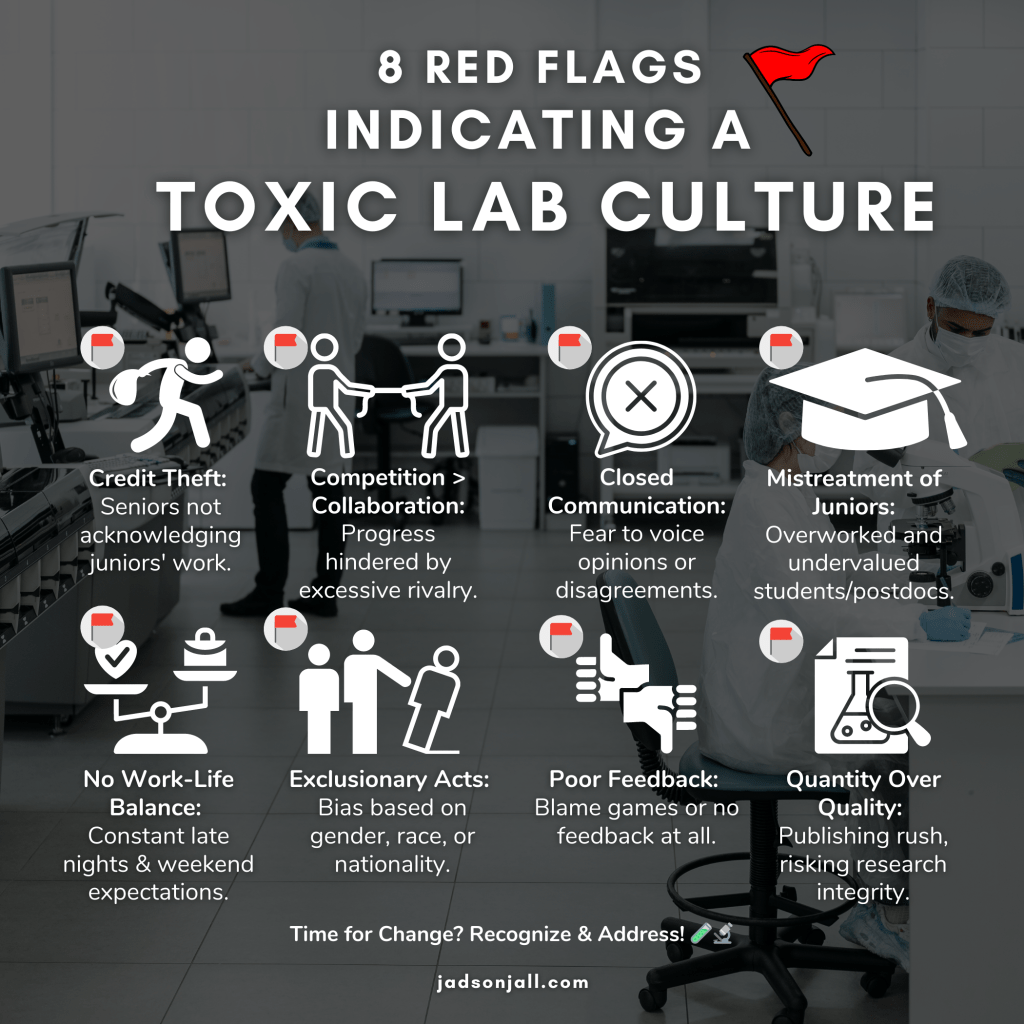
Through meticulous observation and dialogue with many in our field, I’ve distilled some of the most pressing indicators of an unhealthy lab environment. It’s crucial for our community to be aware of these red flags, as they not only hinder our research’s progress and quality but also impact the mental and emotional well-being of our brightest minds.
🔬 Why is this important? A nurturing and supportive environment is foundational to groundbreaking discoveries and the holistic growth of researchers.
Swipe to see the infographic detailing these warning signs. If they resonate, it might be time to reflect and initiate positive change. Let’s work together to cultivate spaces where science thrives and researchers feel valued.
Embarking on a career in science can be a thrilling journey. However, it requires more than just a deep understanding of your field of study. As early-career scientists, leadership is one of the most valuable skills you can develop. Particularly, decision-making and connection-building, two fundamental pillars of leadership according to the Oxford Leadership Framework, developed by Professor Tim Morris, are crucial in a scientific context.
Decision-making: In a constantly evolving world, the importance of decision-making cannot be overstated. As a leader in the scientific community, you are expected to make decisions that affect your research and have broader implications for your field, funding agencies, and society. Decision-making in science involves:
Careful consideration of data.
Foresight about future trends.
An understanding of the potential impact of these decisions.
Early in your career, you might decide which methodologies to use, which hypotheses to test, or how to interpret your results. As you progress, you may have to determine the direction of your research, collaborations, or even ethical considerations. Developing a structured decision-making approach that balances analytical thinking with intuition can help you navigate these complex decisions and lead your team and career toward successful outcomes.
Connection-building: Leadership in science is not an isolated activity. It requires building solid connections with diverse individuals, including colleagues, mentors, and the broader scientific community. As a leader, you play a crucial role in fostering these relationships.
Effective leaders actively seek to establish connections with people and organizations that can support their research endeavors. This could be through networking at conferences, building partnerships for collaborative projects, or establishing mentor-mentee relationships. Through these connections, you can learn, grow, and make a broader impact in your field.
Leaders in science also play a crucial role in bridging the gap between science and society. They are often called upon to communicate scientific findings to the public, policymakers, or industry partners. Effective communication, empathy, and understanding different perspectives are vital for building these connections.
Decision-making and connection-building are two key aspects of leadership that can significantly enhance your effectiveness as a scientist. As you navigate your career in science, remember that leadership is not about authority but about influencing others toward achieving shared objectives. Embrace the leadership challenge; it can open up incredible opportunities for you and your scientific endeavors.
Making the leap from an academic laboratory to one in the industry often feels like entering a whole new world. The environment, objectives, and pace contrasts can make this transition challenging.
The academic environment nurtures intellectual freedom. A researcher might have the liberty to tailor their investigation and undertake in-depth exploration.
In the cloistered halls of academia, curiosity reigns supreme. Researchers delve into the unexplored, seeking to expand the frontiers of human knowledge. The academic environment nurtures intellectual freedom. A researcher might have the liberty to tailor their investigation and undertake in-depth exploration. While collaborations occur, individuals often enjoy considerable autonomy in sculpting their research trajectory.
On the flip side, industry laboratories are beehives of practicality. Here, the watchwords are application, efficiency, and market viability. The ethos is geared towards creating products or solutions that directly impact the market and, by extension, society. Consequently, the pace is more breakneck, as stringent deadlines exist. Industry labs are also usually more “resource-rich” compared to their academic counterparts. However, this “advantage” comes with the burden of expectations: deliverables must be concrete and produced in a timely fashion. Moreover, industry settings usually emphasize teamwork, where cross-functional collaboration is not just encouraged but often essential.
industry settings usually emphasize teamwork, where cross-functional collaboration is not just encouraged but often essential.
The key is recognizing that these two worlds are two sides of the same coin. Academic labs form the bedrock of basic science, which is vital for advancements. Industry labs take these advancements and morph them into real-world applications. They are interdependent.
For individuals transitioning between these environments, it is essential to adapt by recognizing and respecting the unique attributes of each setting. Furthermore, academia and industry have a golden opportunity to forge stronger bonds. By fostering better communication and collaboration, there is a potential to create a conduit for the seamless flow of knowledge and resources. This connection could culminate in a hybrid model, where knowledge is pursued with a focus on practicality.
In conclusion, the apparent culture shock between academic and industry labs signifies diverse approaches and objectives. If harnessed through collaboration and mutual respect, this diversity could be the fulcrum for propelling innovation into uncharted territories.
In the dynamic realm of scientific research, effective leadership is paramount. The Oxford Leadership Framework presents a comprehensive guide for scientists stepping into leadership roles. The four key components of the framework are vision, engagement, decision-making, and connecting. This article focuses on how the first two – vision and engagement – can be applied to leadership development in the research context.
Vision: In the context of scientific research, a leader’s vision outlines the future direction of the team, lab, or institution. It is fundamentally future-oriented, defining where the group is headed. This vision incorporates both the ‘why’ – the purpose of their collective endeavor, which is often rooted in the quest for knowledge and societal advancement – and the ‘how’ – the strategic steps they will take to achieve their goals.
For scientists, the ‘how’ often involves designing and implementing robust research methodologies, pursuing funding opportunities, or establishing collaborations with other research entities. The ‘why’ often addresses larger questions about their research contribution to their field, to knowledge more broadly, and to societal challenges.
However, more than having a vision is required; leaders must communicate it compellingly. A narrative or storyline can be a powerful tool for conveying a vision in a way that is understandable and inspiring to others. For scientists, this might mean framing their research goals within the context of broader scientific challenges or societal needs and articulating how their work contributes to addressing these.
Engagement: The second element of the Oxford Leadership Framework is engagement, which is about motivating people, building commitment, and coordinating people’s activities. In the context of scientific research, engagement involves fostering a sense of shared purpose and collaboration among team members.
Scientific research often involves complex, long-term projects that require the efforts of many individuals with diverse skills. As such, leaders must work to ensure that everyone feels valued and understands how their role contributes to the broader vision. This might involve regular team meetings to discuss progress and challenges, individual check-ins to provide feedback and support, and efforts to build a supportive, inclusive team culture.
To effectively engage their team, scientists should also strive to create an environment where questions and open discussions are welcomed, where every team member feels heard, and where the collective wisdom of the team is used to make decisions. In this way, scientists can foster a sense of ownership and commitment among team members, boosting morale and productivity.
Applying the Oxford Leadership Framework can provide a valuable roadmap for leadership development in academia, especially for early career scientists. The principles of vision and engagement offer practical guidance for scientists stepping into leadership roles, helping them to effectively communicate their research goals and foster a collaborative, engaged team environment. As we navigate the ever-evolving landscape of scientific research, these leadership skills will be increasingly necessary for driving innovation and progress.
Leadership style, defined by the approach and methodology used by a leader to guide and influence their team, can have a significant and tangible impact on the culture of the scientific environment and the productivity of research efforts. This influence can be seen in how decisions are made, how communication is facilitated, and how team members are motivated and organized toward accomplishing shared goals.
Given the importance of this subject, it is worth examining some of the most common leadership styles and understanding how each of them can uniquely impact the scientific environment and research productivity.
Authoritarian or Autocratic Leadership: This style is characterized by individual control over all decisions and little input from team members. In a scientific environment, this could lead to expedited decision-making and clear, straightforward directives. However, it may stifle creativity, discourage independent thought, and lead to low morale. Autocratic leadership might work well for routine and specific tasks but could limit research productivity which generally requires innovative and creative thinking.
Democratic or Participative Leadership: This style encourages team member participation in decision-making processes. In a scientific environment, this can foster a sense of ownership and engagement among researchers, promote a diversity of ideas, and lead to innovative solutions. However, it may also slow down decision-making and complicate processes with excessive discussion. On balance, it’s likely to enhance research productivity by fostering a more committed and innovative team.
Transformational Leadership: Transformational leaders inspire their team with a shared vision of the future. They’re often charismatic and lead by example. In a scientific setting, they can inspire researchers to transcend their personal interests for the good of the team or the project, leading to increased motivation and productivity. They can create an environment where creativity and innovation are highly valued, directly boosting research productivity.
Transactional Leadership: This leadership style is focused on reward and punishment, with leaders setting clear goals and expectations for their team. In a scientific environment, this could lead to high efficiency as everyone knows what is expected of them. However, it might limit creative thinking and innovation, as it doesn’t encourage thinking outside of the box or challenging established norms.
Laissez-faire or Delegative Leadership: In this style, leaders provide little direction or feedback, leaving decision-making up to individual team members. In a scientific environment, this could foster independence, creativity, and innovation, but it might also lead to a lack of direction, inconsistent results, and low productivity if team members are not self-motivated or lack the necessary expertise.
Servant Leadership: Servant leaders prioritize the needs of the team and seek to serve rather than command. In a scientific setting, this could lead to a highly motivated, respected, and cohesive team that’s willing to put in extra effort, thereby improving research productivity. It also fosters a positive work environment where ideas and collaboration are valued.
Each leadership style has its advantages and disadvantages. The best leaders often adapt their style to the situation, the task at hand, and the individual needs and skills of their team members. Effective leadership in science often involves a combination of these styles, balancing the need for clear direction with the fostering of innovation and creativity.
Collaboration is essential in research, offering benefits like increased productivity, better problem-solving, and expanded access to resources. However, interpersonal interactions and complex projects can present challenges that negatively impact research. In this article, I discuss the benefits and challenges of collaboration and strategies for improving collaborative efforts in research.
Benefits and Challenges of Collaboration
High-quality publications and significant research impact can result from collaborations, boosting career development and networking opportunities for researchers. Despite these advantages, challenges may include differences in research priorities, communication barriers, and conflicts in decision-making. Intellectual property, data-sharing, and authorship issues can also emerge, leading to ethical concerns. Researchers must be aware of these challenges and develop strategies to address them.
Strategies for Collaboration
1. Training programs and communication skills development
Participate in workshops or courses focused on collaborative skills, active listening, team-building, and conflict resolution. These programs can help you understand collaboration dynamics and develop essential skills for effective teamwork. When collaborating with international scientific teams, consider learning other languages or cultural norms to improve your ability to communicate and understand different perspectives.
2. Collaborative tools and celebrating milestones
Use collaborative software and tools (such as Slack, Trello, and Google Docs) to streamline communication, project management, and data-sharing. Using these tools, we can understand milestones and celebrate the achievements and contributions of team members. Acknowledging successes can motivate researchers, foster a sense of ownership, and strengthen collaborative relationships.
3. Clear expectations and guidelines
At the beginning of a collaboration, define clear goals, objectives, and individual responsibilities to make the collaboration clearer and more focused on the proposed results. Create guidelines for decision-making, conflict resolution, data-sharing, authorship, and intellectual property to minimize misunderstandings and potential conflicts about the details of the project.
4. Trust and rapport
Invest time in building trust and rapport among collaborators by promoting open communication, sharing credit for successes, and addressing challenges constructively. A strong foundation of trust can foster a positive working environment by strengthening the connections between team members.
5. Regular progress meetings
Schedule regular meetings to discuss project progress, address challenges, and ensure alignment among collaborators. These meetings can help maintain momentum, provide opportunities for feedback, and keep the project on track.
Collaboration plays a crucial role in research. Researchers can overcome the inherent challenges by implementing clear strategies and fostering successful collaborations. Adopting these five strategies can improve collaboration, leading to fruitful research outcomes and stronger professional relationships.
Jadson Jall (left corner) with the dean of the University of São Paulo, Carlos Gilberto Carlotti Júnior (in the center), and other leaders during the first day of the event.
As an esteemed representative selected for the title of Young Leader for Education, I had the privileged opportunity to attend the prestigious 5th Universia International Rectors’ Summit in Valencia, Spain, this May (2023). Notably sponsored by Banco Santander, the Summit carried an ambitious theme: “University and Society,” underscoring the integral role higher education institutions play in sculpting a sustainable, inclusive, and equitable society.
Drawing nearly 700 rectors and academic leaders from 14 countries, the Summit provided an unparalleled platform for engaging in discussions around the future of education. A plethora of perspectives was at hand, representing 14 million students spread across the academic spheres of Europe, the United States, and Latin America.
One overarching sentiment that reverberated throughout the event was the crucial need for synergistic collaboration – not just among universities but also with governments, industry stakeholders, and society at large. As we delve into the era of lifelong learning, it’s incumbent upon us to leverage these collaborative ties to holistically prepare our students for the world of tomorrow.
“the crucial need for synergistic collaboration – not just among universities, but also with governments, industry stakeholders, and society at large.”
There was a consensus on the necessity of reimagining traditional learning paradigms to accommodate the evolving demands of our contemporary world. The attendees agreed on promoting cross-disciplinary skill development, championing innovative teaching models, and harnessing the power of technology to foster a culture of lifelong learning.
We also pondered the essential role of universities as crucibles of entrepreneurship and innovation. By cultivating a vibrant entrepreneurial ecosystem and streamlining the process of technology transfer, universities can effectively respond to societal challenges, propelling economic growth and fostering social welfare.
The third focal discussion revolved around the premise of ‘networks and interconnectivity’. Emphasizing the relevance of academic mobility and open science, we explored the myriad benefits of close-knit cooperation between universities and industry. Such alliances, we believe, are instrumental in driving social and economic development, acting as the stepping-stones towards a future steeped in shared progress.
The conference culminated in the “Valencia Declaration,” a testament to the unwavering commitment of the attendees towards reinforcing the mission of universities. This seminal document envisions universities as vital powerhouses of societal transformation, dedicated to addressing global environmental, social, and economic challenges.
In conclusion, the 5th Universia International Rectors’ Summit underscored the significance of collaboration, marking it as the linchpin to enable universities to contribute more effectively to the well-being of our communities and society.
It made it clear that our universities do not exist in a vacuum. They are part of a broader ecosystem encompassing governments, industries, and societies. Hence, collaboration becomes not a mere choice but a necessity for nurturing an educational environment that enables future leaders to thrive.
“universities do not exist in a vacuum. They are part of a broader ecosystem encompassing governments, industries, and societies.”
As a Young Leader for Education, my takeaway from this influential event is that we should strive to break the silos within which we operate. By fostering meaningful connections across sectors, we can collectively amplify our efforts to shape a better, more inclusive future. This experience has reaffirmed my commitment to promoting synergy between universities, governments, industry, and society in our quest for sustainable growth and equitable education. As I reflect on these insights, I am hopeful that we, together, can push the boundaries of what’s possible in higher education and beyond.
In today’s rapidly evolving world, the importance of collaboration in science cannot be overstated. As our global challenges grow increasingly complex, the need for diverse perspectives, interdisciplinary approaches, and shared resources has become more critical than ever. In this article, I explore five key insights from peer-reviewed articles that highlight the immense value of collaboration in advancing scientific knowledge and addressing pressing issues facing humanity.
Fostering Interdisciplinary Collaboration for Innovative Solutions
As Choy and Lidstone (2013) aptly put it, “Interdisciplinary collaboration is essential for the advancement of knowledge, as it fosters the integration of diverse perspectives and promotes innovative solutions to complex problems.” When scientists from different fields come together, they bring unique insights and expertise that can lead to groundbreaking discoveries. By working together, experts from various disciplines can identify previously overlooked connections and tackle multifaceted problems with greater precision, ultimately leading to more innovative and effective solutions.
The Power of Collaborative Research Networks
Scientific collaboration extends beyond individual partnerships to the formation of broader research networks. Newman (2001) underscores the importance of these networks, stating that “collaborative research networks stimulate productivity, accelerate the dissemination of knowledge, and contribute to the development of emerging fields in science.” These networks facilitate the exchange of ideas and resources, enabling scientists to build on each other’s work and move the collective knowledge forward at a faster pace. Collaborative research networks also help to bridge gaps between scientific disciplines, fostering a more holistic understanding of complex phenomena.
International Collaboration in Science for Global Challenges
In our increasingly interconnected world, scientific challenges often extend beyond national borders, necessitating international collaboration. Wagner and Leydesdorff (2005) emphasize the importance of global cooperation, asserting that “international collaboration in science is crucial for addressing global challenges that transcend national borders, as it facilitates the pooling of resources, expertise, and infrastructure.” By working together across countries, scientists can share knowledge, data, and technologies, creating a global scientific community that is better equipped to tackle pressing issues like climate change, pandemics, and resource scarcity.
The Benefits of Collaborative Research Partnerships
Collaborative research partnerships offer numerous benefits to both individual researchers and the broader scientific community. Bennett and Gadlin (2012) highlight the advantages of such partnerships, stating that they “not only benefit individual researchers but also enhance the scientific community as a whole by fostering a culture of open communication, sharing, and mutual support.” Collaborative research efforts can lead to faster progress by combining the expertise and resources of multiple researchers, while the open exchange of ideas can spur creativity and innovation. Additionally, collaboration helps to create a supportive research environment where scientists can learn from one another and grow both personally and professionally.
Driving Innovation through Effective Collaboration
Lastly, effective collaboration in science is key to driving innovation and ensuring the reliability of research findings. Stokols, Hall, Taylor, and Moser (2008) emphasize the importance of collaboration, stating that it “promotes the exchange of ideas, encourages critical thinking, and reduces the risk of research bias.” By working together, scientists can challenge each other’s assumptions, identify potential pitfalls, and ultimately arrive at more robust and reliable conclusions. Collaboration also enables researchers to approach problems from multiple angles, fostering a more comprehensive understanding of complex issues and leading to innovative breakthroughs.
In conclusion, the importance of collaboration in science is undeniable. From fostering interdisciplinary approaches and collaborative research networks to promoting international cooperation and driving innovation, collaboration plays a vital role in advancing scientific knowledge and addressing the complex challenges facing our world. By embracing the power of collective intelligence and harnessing the benefits of collaboration, the scientific community can accelerate progress and make a greater impact on the pressing issues
References:
Bennett, L. M., & Gadlin, H. (2012). Collaboration and team science: from theory to practice. Journal of Investigative Medicine, 60(5), 768-775.
Choy, S. L., & Lidstone, J. (2013). Interdisciplinary research: collaboration at the nexus of science, policy, and practice. Journal of Environmental Studies and Sciences, 3(1), 64-71.
Newman, M. E. (2001). Scientific collaboration networks. I. Network construction and fundamental results. Physical Review E, 64(1), 016131.
Stokols, D., Hall, K. L., Taylor, B. K., & Moser, R. P. (2008). The science of team science: Overview of the field and introduction to the supplement. American Journal of Preventive Medicine, 35(2 Suppl), S77-S89.
Wagner, C. S., & Leydesdorff, L. (2005). Network structure, self-organization, and the growth of international collaboration in science. Research Policy, 34(10), 1608-1618.












 Jadson Jall, PhD