This article originally appeared as part of the Early Career Scientists Weekly Newsletter from the Genetics Society of America (GSA).
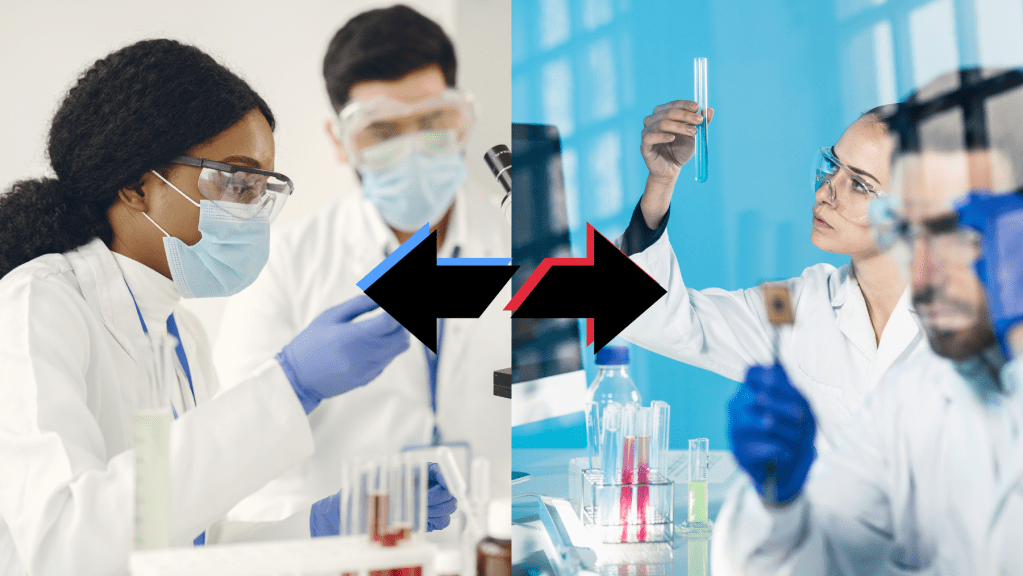
Making the leap from an academic laboratory to one in the industry often feels like entering a whole new world. The environment, objectives, and pace contrasts can make this transition challenging.
The academic environment nurtures intellectual freedom. A researcher might have the liberty to tailor their investigation and undertake in-depth exploration.
In the cloistered halls of academia, curiosity reigns supreme. Researchers delve into the unexplored, seeking to expand the frontiers of human knowledge. The academic environment nurtures intellectual freedom. A researcher might have the liberty to tailor their investigation and undertake in-depth exploration. While collaborations occur, individuals often enjoy considerable autonomy in sculpting their research trajectory.
On the flip side, industry laboratories are beehives of practicality. Here, the watchwords are application, efficiency, and market viability. The ethos is geared towards creating products or solutions that directly impact the market and, by extension, society. Consequently, the pace is more breakneck, as stringent deadlines exist. Industry labs are also usually more “resource-rich” compared to their academic counterparts. However, this “advantage” comes with the burden of expectations: deliverables must be concrete and produced in a timely fashion. Moreover, industry settings usually emphasize teamwork, where cross-functional collaboration is not just encouraged but often essential.
industry settings usually emphasize teamwork, where cross-functional collaboration is not just encouraged but often essential.
The key is recognizing that these two worlds are two sides of the same coin. Academic labs form the bedrock of basic science, which is vital for advancements. Industry labs take these advancements and morph them into real-world applications. They are interdependent.
For individuals transitioning between these environments, it is essential to adapt by recognizing and respecting the unique attributes of each setting. Furthermore, academia and industry have a golden opportunity to forge stronger bonds. By fostering better communication and collaboration, there is a potential to create a conduit for the seamless flow of knowledge and resources. This connection could culminate in a hybrid model, where knowledge is pursued with a focus on practicality.
In conclusion, the apparent culture shock between academic and industry labs signifies diverse approaches and objectives. If harnessed through collaboration and mutual respect, this diversity could be the fulcrum for propelling innovation into uncharted territories.
 Jadson Jall, PhD