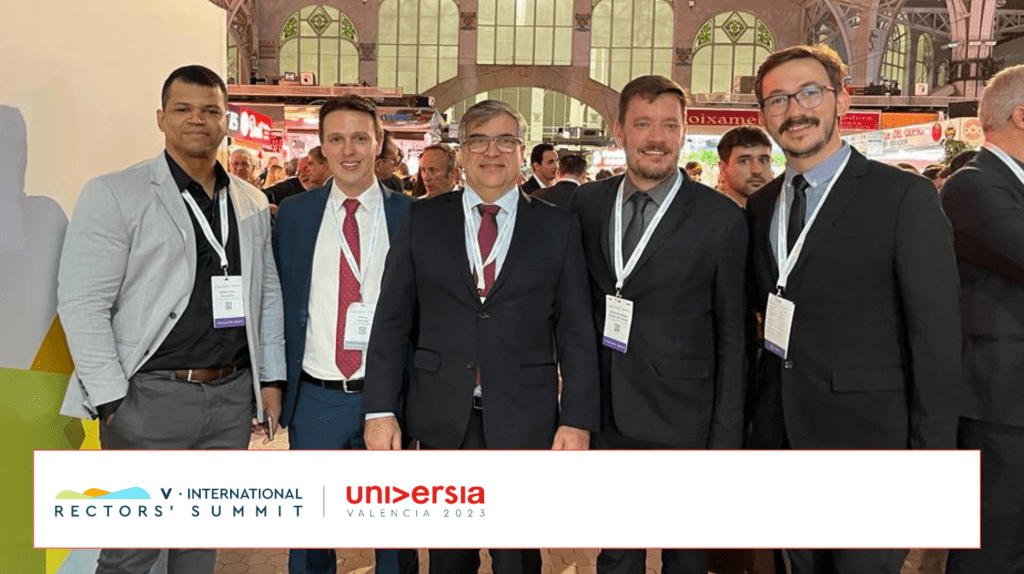
Jadson Jall (left corner) with the dean of the University of São Paulo, Carlos Gilberto Carlotti Júnior (in the center), and other leaders during the first day of the event.
As an esteemed representative selected for the title of Young Leader for Education, I had the privileged opportunity to attend the prestigious 5th Universia International Rectors’ Summit in Valencia, Spain, this May (2023). Notably sponsored by Banco Santander, the Summit carried an ambitious theme: “University and Society,” underscoring the integral role higher education institutions play in sculpting a sustainable, inclusive, and equitable society.
Drawing nearly 700 rectors and academic leaders from 14 countries, the Summit provided an unparalleled platform for engaging in discussions around the future of education. A plethora of perspectives was at hand, representing 14 million students spread across the academic spheres of Europe, the United States, and Latin America.
One overarching sentiment that reverberated throughout the event was the crucial need for synergistic collaboration – not just among universities but also with governments, industry stakeholders, and society at large. As we delve into the era of lifelong learning, it’s incumbent upon us to leverage these collaborative ties to holistically prepare our students for the world of tomorrow.
“the crucial need for synergistic collaboration – not just among universities, but also with governments, industry stakeholders, and society at large.”
There was a consensus on the necessity of reimagining traditional learning paradigms to accommodate the evolving demands of our contemporary world. The attendees agreed on promoting cross-disciplinary skill development, championing innovative teaching models, and harnessing the power of technology to foster a culture of lifelong learning.
We also pondered the essential role of universities as crucibles of entrepreneurship and innovation. By cultivating a vibrant entrepreneurial ecosystem and streamlining the process of technology transfer, universities can effectively respond to societal challenges, propelling economic growth and fostering social welfare.
The third focal discussion revolved around the premise of ‘networks and interconnectivity’. Emphasizing the relevance of academic mobility and open science, we explored the myriad benefits of close-knit cooperation between universities and industry. Such alliances, we believe, are instrumental in driving social and economic development, acting as the stepping-stones towards a future steeped in shared progress.
The conference culminated in the “Valencia Declaration,” a testament to the unwavering commitment of the attendees towards reinforcing the mission of universities. This seminal document envisions universities as vital powerhouses of societal transformation, dedicated to addressing global environmental, social, and economic challenges.
In conclusion, the 5th Universia International Rectors’ Summit underscored the significance of collaboration, marking it as the linchpin to enable universities to contribute more effectively to the well-being of our communities and society.
It made it clear that our universities do not exist in a vacuum. They are part of a broader ecosystem encompassing governments, industries, and societies. Hence, collaboration becomes not a mere choice but a necessity for nurturing an educational environment that enables future leaders to thrive.
“universities do not exist in a vacuum. They are part of a broader ecosystem encompassing governments, industries, and societies.”
As a Young Leader for Education, my takeaway from this influential event is that we should strive to break the silos within which we operate. By fostering meaningful connections across sectors, we can collectively amplify our efforts to shape a better, more inclusive future. This experience has reaffirmed my commitment to promoting synergy between universities, governments, industry, and society in our quest for sustainable growth and equitable education. As I reflect on these insights, I am hopeful that we, together, can push the boundaries of what’s possible in higher education and beyond.
 Jadson Jall, PhD